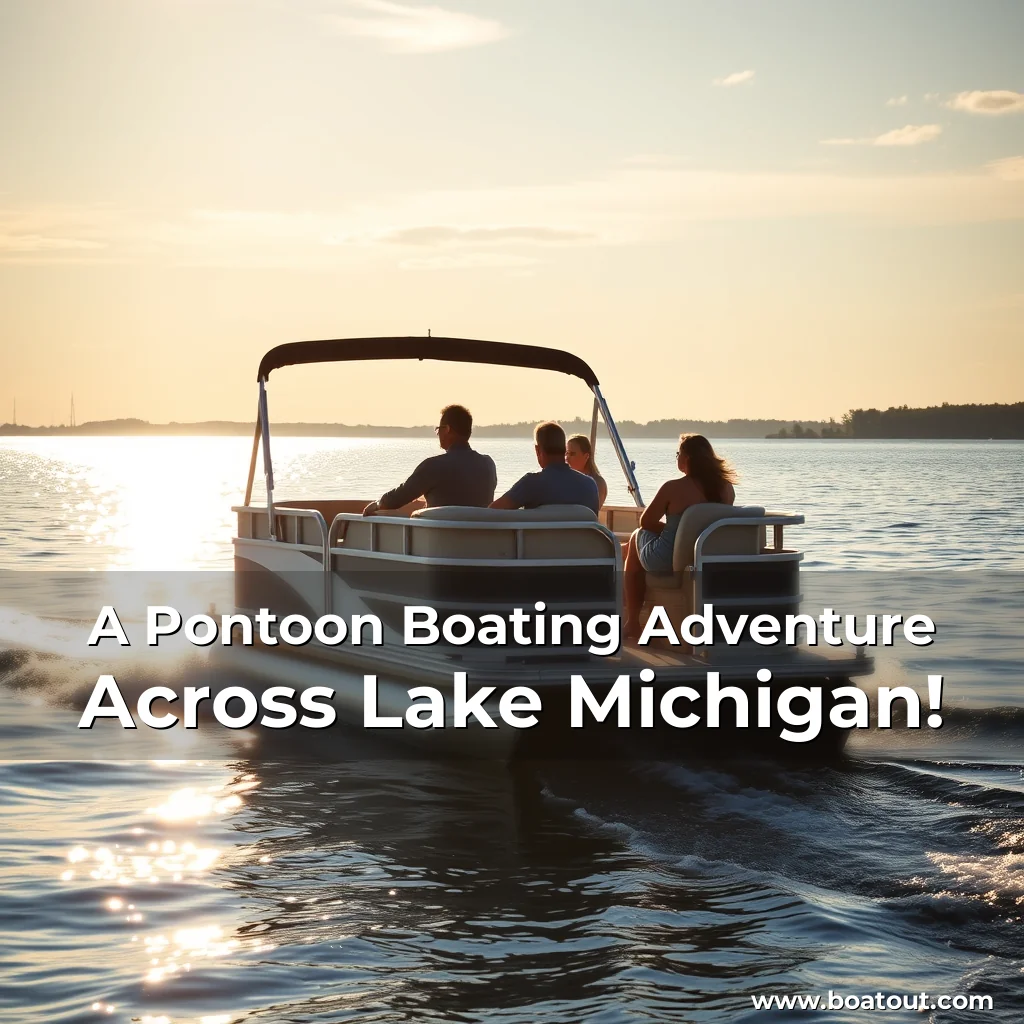
A Pontoon Boating Adventure Across Lake Michigan!
March 14, 2025 | Boating adventures
I don’t know if I can do this,” Sutter says, as he looks at the lake.
He had a few tricks up his sleeve, but we were all aware that the voyage was still subject to the unpredictable seas. The weather forecast was uncertain, and the route was fraught with potential hazards, including rocky shores, strong currents, and unpredictable waves. Goofy, however, was confident in his ability to navigate the vessel, having made the crossing in 1999 with the help of a small crew. The conditions were far from ideal, with the vessel being overhauled and needing to be sea-worthy. The crew consisted of Goofy, his brother-in-law, and a young sailor named Tom. Tom was an experienced sailor, but his inexperience with the vessel was evident, and the vessel was in need of repair, which made the journey even more precarious. The conditions were far from ideal, with the voyage taking place during a severe weather warning. The storm was intensifying, with strong winds and massive waves. The vessel was taking on water, and the crew was struggling to keep her afloat. Despite the dire circumstances, Goofy remained confident in his ability to navigate the vessel and ensure their safe passage. However, the crew was getting increasingly desperate as the situation worsened. Tom was getting anxious, and his inexperience was starting to show.
“I was always getting into trouble, and my dad was always getting me out of it.”
A Childhood of Adventure
Sohm’s love for boating and the water began at a young age. He spent countless hours on the shores of Lake Winnebago, exploring the surrounding woods and learning about the local wildlife. His father, a skilled boater himself, would often take Sohm on trips around the lake, teaching him the basics of navigation and safety.
His friend, John, bought him a fiberglass boat that was the size of a pool. Sohm spent the entire summer sailing it on Lake Winnebago in Wisconsin. He got seasick. He learned to sail on the water and improved his skills through dedication and perseverance. Sohm became a professional sailor. He sailed around the world and completed several offshore racing events.
He was a passenger, but he was also a passenger on the boat’s journey to the bottom of the ocean.
As they descended into the darkness, the silence was oppressive. The only sound was the gentle hum of the boat’s engines and the soft hiss of the air supply. Sohm felt a sense of calm wash over him, a sense of being in the presence of something much greater than himself.
As they reached the bottom, Sohm felt a sense of awe wash over him. The Challenger Deep was a vast, dark expanse, a seemingly endless void.
The pontoon was then transported to the lake and assembled on-site.
The Pontoon’s Assembly and Installation
The pontoon was transported to the lake and assembled on-site. The local sheet-metal shop had formed the tubes in two pieces, which were then welded together to create a single, solid unit.
The boat was a hit, and Sohm was invited to participate in the 1999 Pontoon and Deck Boat magazine shootout.
The Impact of the Pontoon Boat on the Industry
The introduction of the pontoon boat revolutionized the industry in several ways. Some of the key impacts include:
The Legacy of the Pontoon Boat
The pontoon boat has left a lasting legacy in the industry, with many manufacturers continuing to innovate and improve their designs.
This innovation allowed the strakes to lift the hull out of the water, reducing drag and increasing speed.
The T.A.P. is a revolutionary innovation in pontoon boat design.
“I figured if I could get people talking about my business, I could get people to come and visit me.”
The Concept Behind the Crossing
Sohm’s idea was to cross Lake Michigan on a kayak, using a combination of paddling and sailing to cover the 87 miles.
“We were lucky to get out of there alive.”
The Perilous Journey
The journey began on a stormy night, with Sohm and his crew navigating through the treacherous waters of the Gulf of Mexico. The storm had been brewing for days, and the crew was not prepared for the ferocity of the winds and waves.
The three of us set off from the Chesapeake Bay Bridge-Tunnel, bound for the Outer Banks.Preparing for the Crossing
To prepare for the crossing, we needed to ensure our vessels were seaworthy and equipped with the necessary safety gear. Sohm’s Bentley pontoon was a sturdy vessel, but we still needed to check its systems and make any necessary repairs. Kay and I inspected our boats, making sure our engines were in good working order and that our safety equipment was in working condition. • We also made sure to check the weather forecast and sea conditions before departing.
The winds were howling, the waves were towering, and the seas were a churning mess of white foam and dark water. The rain was coming down in sheets, and the wind was so strong it was making it difficult to stand. The gusts were so intense that they were knocking over trees and power lines, causing widespread power outages. The waves were over 20 feet high, with some reaching up to 30 feet.
In 1999 it took almost 90 gallons to make the same distance plus 20 off-course miles. Our fuel economy was about three times better in 2024. And the ride was much less dramatic, thanks mostly to that third tube under the boat.
We were in the middle of the ocean, but it was not the vast, open ocean I had imagined.
The response is universal: What a goofy thing to run three hours to get to a place that’s only 10 miles away.
The Psychology of the Return Run
So, why do people do the return run? Is it a form of protest, a way to avoid the hassle of continuing on to a destination, or simply a quirk of human nature? The answer lies in the psychology of the return run. According to experts, the return run is often a result of cognitive dissonance, a feeling of discomfort or tension that arises when an individual is faced with a situation that contradicts their expectations or values.

news is a contributor at BoatOut. We are committed to providing well-researched, accurate, and valuable content to our readers.