Triple amputee Craig Wood prepares for 80 day solo Pacific crossing
February 20, 2025 | BoatOut
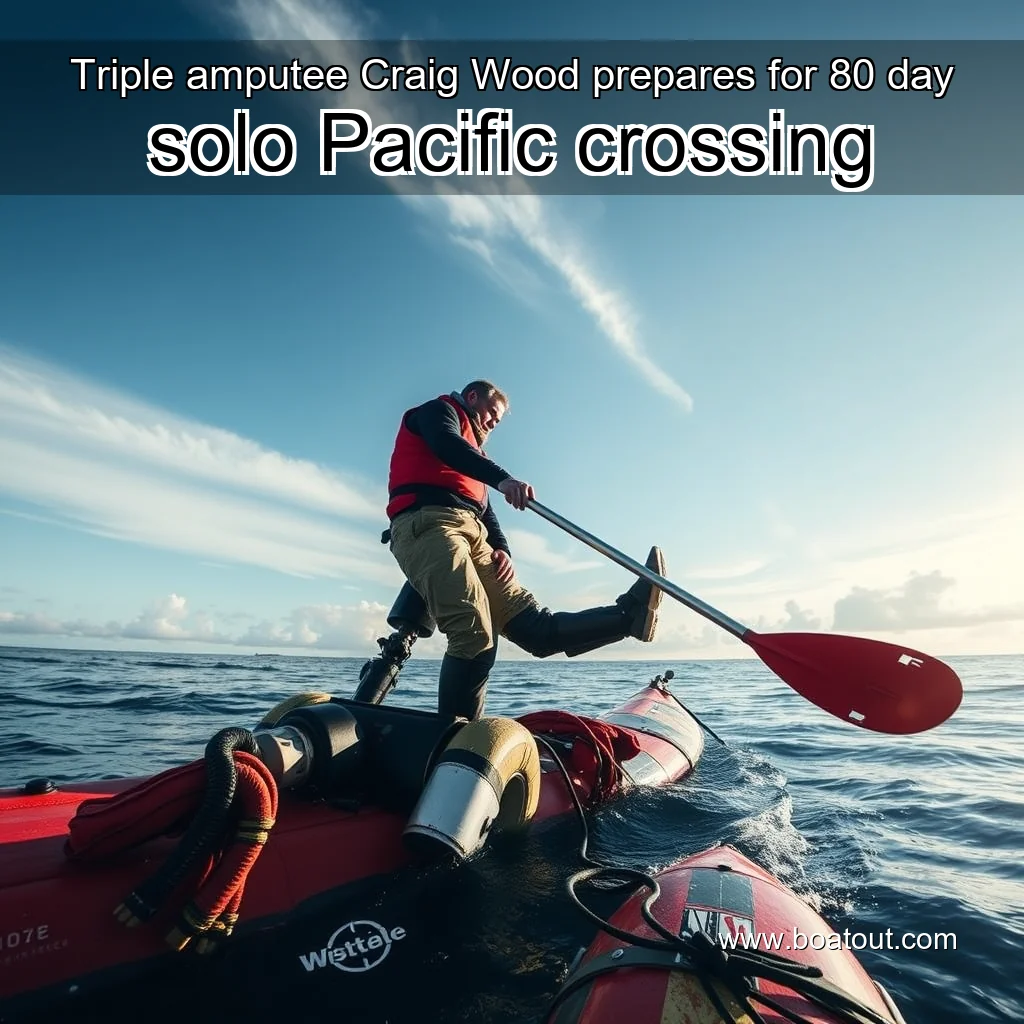
Sailing for 80 days solo, non-stop and unsupported 6,000 miles across the Pacific would be a daunting enough voyage for many people. Craig Wood, a 33-year-old former Army rifleman from Doncaster, has the additional challenge of being a triple amputee. The self-confessed ‘sailing geek’ is determined to “change perceptions of what disabled people can do and show that sailing is a sport for everyone.” He told PBO: “My level of knowledge is the same as any able-bodied sailor, they may be able to implement it faster but I find a way. “So it creates a level playing field. I can do one-handed bowlines because I’ve got no other choice.
He will be accompanied by his wife, who will be sailing solo for the first time. The couple will be joined by a third crew member, who will be sailing solo for the first, and second, time. The three will be sailing to the Galapagos Islands, then on to the Marquesas Islands, and finally to the Tuamotu archipelago in French Polynesia.
The Journey Begins
Craig and his crew will embark on an epic adventure that will take them across the Pacific Ocean, covering a distance of over 6,000 nautical miles. The journey will be a test of endurance, both physically and mentally, as they face the challenges of the open sea, including rough weather, equipment failures, and the ever-present risk of accidents. Key challenges they will face: + Rough weather and storms + Equipment failures and maintenance + Accidents and emergencies + Physical and mental fatigue
Preparing for the Journey
Before setting sail, Craig and his crew will undergo rigorous training and preparation to ensure they are equipped to handle the challenges of the journey.
The Quest for the Perfect Passage
The journey from the UK to Hawaii is a long and arduous one, spanning over 5,000 nautical miles. The conditions that Craig is hoping for are ideal for a smooth and efficient passage. Trade-wind conditions of 15 knots and waves of 1.5m-2m will provide the necessary stability and speed for the yacht to make the journey in record time. Key factors that contribute to a successful passage: + Favorable wind and wave conditions + A well-maintained and optimized yacht + Experienced crew and captain + Proper planning and preparation
The Challenges of the Pacific Ocean
The Pacific Ocean is notorious for its unpredictable and harsh weather conditions. The crew will face numerous challenges, including:
Preparing for the Journey
To overcome the challenges of the Pacific Ocean, Craig and his crew will need to be well-prepared. This includes:
This time, he was determined to complete a 3,000-mile journey across the Atlantic Ocean.
The Unstoppable Spirit of Craig
Craig’s determination to complete the journey was unwavering, despite the odds against him. He had lost both legs and his left hand, but he refused to let his disability define him. With the help of his prosthetic legs and a custom-made prosthetic hand, Craig was ready to take on the challenge of a lifetime.
The Journey Begins
Craig set off from the port of New York, bound for the Canary Islands. He had spent months preparing for this moment, training his body and mind for the grueling journey ahead. As he sailed across the Atlantic, Craig faced numerous challenges, including rough seas and equipment failures. However, he persevered, relying on his experience and determination to overcome each obstacle.
The Power of Adaptation
Craig’s journey was not without its setbacks, but he was able to adapt to each new challenge. He learned to navigate using his prosthetic hand, and he developed a system for managing his prosthetic legs. Craig also relied on his experience as a sailor to troubleshoot equipment failures and make repairs. His ability to adapt was key to his success, and it allowed him to complete the journey despite the odds against him.
The Emotional Toll
Craig’s journey was not just a physical challenge, but also an emotional one. He faced moments of fear, doubt, and frustration, but he was able to push through these emotions and stay focused on his goal.
The Road to Recovery
Craig’s journey to recovery was not an easy one. The road to recovery was long and arduous, filled with setbacks and challenges.
He had a vision of a boat that could sail from the tip of South America to the top of North America, crossing the Atlantic Ocean, and then sail back to the tip of South America. He wanted a boat that could handle the rough seas and strong winds of the Southern Ocean, as well as the calm waters of the Caribbean and the Gulf of Mexico.
The Concept of the Sailboat
Craig’s vision for the sailboat was not just about crossing the oceans, but also about the design and functionality of the boat.
They started dating and eventually got married. Renate is a German national who is also a triple amputee.
A Chance Encounter
Craig and Renate’s chance encounter in Gibraltar marked the beginning of their extraordinary journey together. They met while Craig was on a solo sailing trip, and Renate was hitchhiking to South America. The two shared a passion for adventure and a desire to push beyond their physical limitations. Their initial meeting was a serendipitous encounter that would change the course of their lives forever. Craig and Renate’s shared experiences as triple amputees gave them a unique perspective on life and a deep understanding of each other’s challenges. They quickly realized that their disabilities did not define them, but rather empowered them to pursue their passions and dreams.*
Overcoming Adversity
Craig and Renate’s journey was not without its challenges.
Weather forecasting is crucial for sailing teams to make informed decisions about their strategy.
As a meteorologist, Rowell will be responsible for monitoring the weather conditions and providing critical information to the America’s Cup team.
The Importance of Weather Forecasting in Sailing
Weather forecasting plays a crucial role in sailing, particularly in high-stakes competitions like the America’s Cup. The unpredictable nature of the ocean and the atmosphere makes it challenging to predict weather patterns with certainty. However, with the help of advanced technology and skilled meteorologists, teams can make informed decisions about their sailing strategy.
The Role of Meteorologists in Sailing
Meteorologists like Simon Rowell play a vital role in providing critical weather information to sailing teams. Their expertise in analyzing weather patterns and predicting future conditions enables teams to make informed decisions about their sailing strategy.
He has a SOLAS-approved handheld VHF radio and a waterproof Bluetooth speaker.
The Ultimate Offshore Angler
As the sun rises over the open waters, a lone figure stands at the edge of the horizon, waiting for the day’s catch. This is the life of an offshore angler, where the thrill of the hunt is matched only by the challenge of the elements. For those who dare to venture into the unknown, the rewards are immeasurable.
Gear and Equipment
To tackle the unforgiving ocean, an offshore angler needs the right gear. The Elite Offshore jacket from Henri Lloyd is a top choice, providing windproof and waterproof protection from the elements. But it’s not just about the jacket – the right equipment can make all the difference. SOLAS-approved clip-on LED flare for emergency signaling
The Challenges of Offshore Angling
Offshore angling is not for the faint of heart. The ocean is a harsh environment, with unpredictable weather patterns and treacherous currents.
The family will be staying in a hotel in Tokyo, where they will be able to meet up with Craig and other supporters.
The Journey Begins
Craig’s journey to Japan is a remarkable feat of endurance and determination. He will be cycling 3,000 miles from the UK to Japan, a distance that would be equivalent to cycling around the world. This journey will take him through various landscapes, climates, and cultures, testing his physical and mental limits.
Physical and Mental Challenges
Craig’s journey will not be without its challenges. He will face physical demands such as cycling long distances, navigating through different terrain, and dealing with varying weather conditions. He will also have to cope with mental fatigue, loneliness, and the pressure of meeting his goal. He will be cycling through the night, often with limited visibility and no streetlights, which will require him to rely on his headlamp and other safety equipment. He will have to navigate through busy roads, construction zones, and other hazards that could pose a risk to his safety.
“We were in a pretty good position, but the wind was so strong that it was hard to keep the boat on course.” The article will be about the sailing experience of a sailor who recounts his experience of sailing in a stormy weather.
The Stormy Weather
Sailing in stormy weather can be a thrilling yet intimidating experience for sailors. The sailor in question, who wishes to remain anonymous, shared his harrowing experience of sailing in a stormy weather condition.
The Pre-Storm Preparation
Before the storm hit, the sailor and his crew had been monitoring the weather forecast closely. They had been tracking the storm’s progress, and the sailor had been studying the weather patterns to anticipate the storm’s arrival. The sailor had been checking the wind speed and direction, as well as the wave height and forecasted storm surge. The crew had been preparing the boat for the storm by securing loose items, tightening the rigging, and checking the safety equipment.*
The Storm Hits
As the storm approached, the sailor and his crew were on high alert.
“I want to show that with determination and hard work, anything is possible.”
The Inspiration Behind the Expedition
Craig’s journey began with a personal experience that sparked his passion for adventure and fundraising. He was inspired by the charity work of Blesma and Turn to Starboard, organizations that support people with limb differences and amputees.
Expert advice and stunning photography make PBO the ultimate sailing companion.
PBO is the UK’s leading sailing magazine, and it’s packed with expert advice, stunning photography, and inspiring stories from the world of sailing.
Sailing Tips and Advice
PBO is renowned for its expert advice, which is delivered in a clear and concise manner. The magazine’s team of experienced sailing experts provides readers with practical tips and guidance on everything from boat maintenance and repair to navigation and sailing techniques. Whether you’re a seasoned sailor or just starting out, PBO’s advice is invaluable. Key areas of focus for PBO’s advice include: + Boat maintenance and repair + Navigation and sailing techniques + Safety and emergency procedures + Boat handling and trim + Racing and performance optimization
Stunning Photography and Inspiring Stories
PBO is also known for its stunning photography, which showcases the beauty of the world’s oceans and the incredible sailing experiences that await.

news is a contributor at BoatOut. We are committed to providing well-researched, accurate, and valuable content to our readers.